Consultation Hotline
+1 (302) 618-8777
+1 (302) 618-8777
Current location:Home > Blogs > Company News
Supporting Laboratories with Multi-Brand Flow Cytometry Service Solutions
Lab Revive Services is committed to providing flow cytometer repair and maintenance services to laboratories across the United States. As flow cytometry continues to play an essential role in biomedical research, biotechnology, pharmaceutical development, immunology, and life science applications, reliable instrument performance has become increasingly important for research productivity and data quality.
Flow cytometers are sophisticated analytical instruments that combine optical systems, lasers, fluorescence detectors, fluidics, electronics, and specialized software. Over time, instrument components may experience performance degradation, fluidic blockages, unstable signals, or software-related problems. Professional troubleshooting and preventive maintenance can help laboratories address these issues, minimize unexpected downtime, and extend equipment service life.
Lab Revive Services aims to support laboratories with practical repair and maintenance solutions tailored to their instrument models and operational requirements.
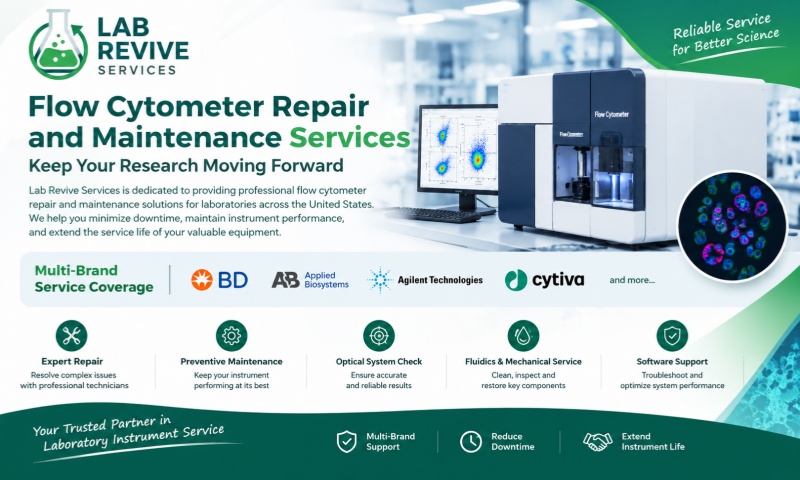
Lab Revive Services can be contacted regarding flow cytometer repair and maintenance requirements involving multiple laboratory instrument brands, including BD, AB/Applied Biosystems, Agilent, Cytiva, and other manufacturers. Service availability depends on the specific instrument model, fault condition, parts availability, and confirmed technical coverage.
Different manufacturers use different instrument architectures, optical configurations, detection technologies, and software platforms. Therefore, effective service begins with identifying the instrument model and understanding the symptoms reported by laboratory personnel.
For BD flow cytometers, for example, troubleshooting may involve fluidic performance, fluorescence signal stability, optical alignment, or sample acquisition problems. AB/Applied Biosystems, Agilent, and Cytiva equipment must likewise be assessed according to the design and service requirements of the specific platform.
By evaluating each service request individually, Lab Revive Services seeks to help customers identify appropriate maintenance procedures and practical repair options.
Flow cytometer maintenance requires attention to several interconnected systems. Depending on the instrument and confirmed service scope, repair and preventive maintenance activities may include:
Optical system inspection: Assessing laser performance, optical alignment, filters, and related components.
Detector troubleshooting: Investigating weak fluorescence signals, unstable measurements, and detector-related abnormalities.
Fluidic system maintenance: Inspecting sample lines, tubing, flow cells, and fluid delivery components for contamination, leaks, or blockages.
Mechanical inspection: Checking sample loading, plate handling, and other applicable mechanical functions.
Software troubleshooting: Investigating acquisition errors, communication problems, and instrument control issues.
Preventive maintenance: Performing appropriate cleaning, component inspections, and operational checks according to instrument requirements.
After repairs, suitable functional checks and performance verification can help determine whether the instrument is operating as expected. Laboratories should follow the applicable manufacturer procedures and use appropriate control materials to evaluate performance.
Unexpected flow cytometer failures can interrupt experiments, delay research projects, and create scheduling challenges for laboratory teams. A structured maintenance strategy helps laboratories identify developing problems before they significantly affect daily operations.
Lab Revive Services recognizes the importance of timely technical assessment, clear communication, and service recommendations that reflect the instrument's condition. When a problem occurs, laboratories can provide the manufacturer, model number, serial number, error messages, and a description of the symptoms to help initiate the diagnostic process.
Preventive maintenance is equally important. Regular cleaning, appropriate fluidic maintenance, inspection of optical components, and performance monitoring can help reduce avoidable failures. Maintenance frequency should be determined by instrument usage, sample characteristics, operating conditions, and manufacturer recommendations.
Beyond individual repair requirements, laboratories must also consider equipment lifecycle management. Aging instruments, changing research needs, and laboratory relocation projects can all affect maintenance decisions.
Lab Revive Services offers broader laboratory equipment services, including repair, maintenance, used instrument solutions, and laboratory relocation support. This service portfolio can be relevant to organizations managing multiple instruments or planning changes to their laboratory facilities.
For laboratories evaluating whether to repair or replace an instrument, a technical assessment and cost comparison can help clarify the available options. Factors such as instrument condition, parts availability, repair costs, expected service life, and application requirements should all be considered.
Lab Revive Services is focused on helping laboratories maintain dependable equipment and manage instrument maintenance requirements more effectively. Its multi-brand service approach provides a point of contact for laboratories seeking assistance with flow cytometers and other laboratory instruments.
Customers interested in BD, AB/Applied Biosystems, Agilent, Cytiva, or other brands should confirm support for their exact model before scheduling service. Not every instrument or component is necessarily covered by the same service capabilities.
As laboratories continue to rely on flow cytometry for advanced research and analytical testing, Lab Revive Services remains committed to supporting equipment reliability through appropriate repair, preventive maintenance, and practical laboratory service solutions.
For flow cytometer service inquiries, laboratories can contact Lab Revive Services with their instrument details and maintenance requirements to discuss the next steps.