
Consultation Hotline
+1 (302) 618-8777
+1 (302) 618-8777
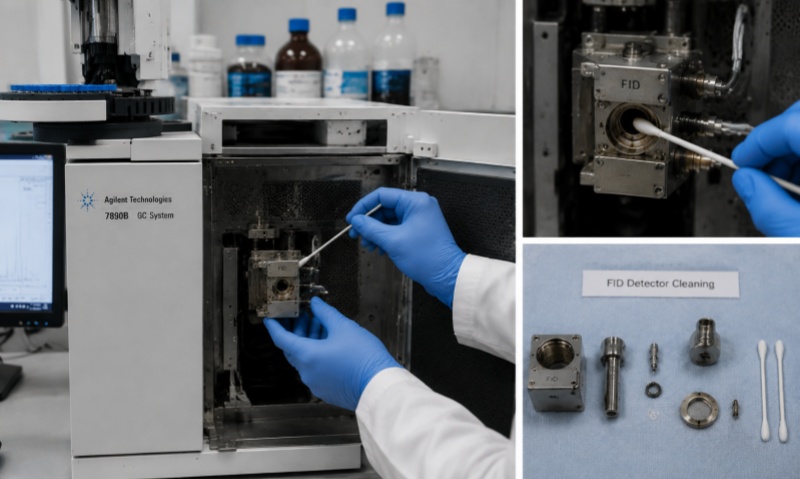
The Flame Ionization Detector (FID) is one of the most widely used detectors in gas chromatography (GC) due to its high sensitivity, wide linear range, and excellent response to organic compounds. However, continuous exposure to sample residues, column bleed, non-volatile contaminants, and combustion byproducts can gradually affect detector performance. Symptoms such as increased baseline noise, signal instability, reduced sensitivity, peak tailing, and ignition difficulties often indicate that cleaning is required.
Understanding the appropriate cleaning methods for a GC FID is essential for maintaining analytical accuracy, extending detector lifespan, and reducing instrument downtime. This article discusses different FID cleaning techniques, their applications, and best practices for laboratory maintenance.
An FID operates by burning hydrogen and air to create a stable flame. Organic compounds eluting from the GC column are ionized within the flame, generating a measurable electrical current. Over time, contaminants accumulate in critical detector components, including:
Jet or nozzle
Collector electrode
Insulator assembly
Detector body
Ignition components
Gas flow passages
Contamination can originate from:
Dirty samples
High-boiling compounds
Silicone column bleed
Derivatization reagents
Lubricants and septum particles
Incomplete combustion products
Regular cleaning prevents these materials from interfering with detector operation and analytical performance.
Thermal cleaning, often referred to as detector bakeout, is the simplest maintenance procedure.
Remove samples from the sequence.
Increase detector temperature to the manufacturer's recommended maximum operating temperature.
Maintain elevated temperature for several hours.
Continue flowing detector gases according to instrument specifications.
Monitor baseline stability after cooling.
Requires no disassembly.
Removes volatile contaminants.
Reduces baseline drift caused by light residues.
Minimizes downtime.
Ineffective against carbonized deposits.
Cannot remove physical blockages.
Limited effectiveness for severe contamination.
Thermal cleaning is best used as a preventive maintenance practice rather than a solution for heavily contaminated detectors.
The jet is among the most critical components of the FID. Small amounts of contamination can significantly affect flame stability and detector response.
Difficulty igniting the flame
Flame outages
Reduced detector sensitivity
Unstable baseline
Increased noise
Shut down the GC and allow the detector to cool.
Turn off gas supplies.
Remove the detector jet carefully.
Inspect for visible deposits.
Clean using appropriate solvents such as methanol, acetone, or isopropanol.
Use a fine cleaning wire approved by the manufacturer to remove obstructions.
Dry completely before reinstallation.
Never enlarge the jet opening.
Avoid using excessive force.
Use only approved cleaning tools.
Prevent scratching of the jet surface.
Regular jet cleaning often restores detector performance without requiring extensive maintenance.
Solvent cleaning is commonly used when contamination extends beyond the jet and affects the collector assembly or detector body.
Commonly used solvents include:
Methanol
Isopropanol
Acetone
Hexane
Dichloromethane (where permitted by laboratory procedures)
The solvent selection should always be compatible with detector materials and manufacturer recommendations.
Disassemble the detector according to service guidelines.
Immerse metal components in solvent.
Use lint-free swabs to remove deposits.
Rinse thoroughly.
Allow components to dry completely.
Reassemble and verify proper alignment.
Effective for removing oils and organic residues.
Relatively inexpensive.
Suitable for routine maintenance.
Does not remove heavy carbon deposits effectively.
Requires careful handling of detector parts.
Ultrasonic cleaning is highly effective for removing stubborn contamination from metal detector components.
High-frequency sound waves generate microscopic cavitation bubbles in the cleaning solution. These bubbles dislodge contaminants from surfaces and difficult-to-reach areas.
Remove metal detector components.
Place them in a suitable cleaning solvent.
Position the container in an ultrasonic bath.
Clean for 10–30 minutes depending on contamination levels.
Rinse with clean solvent.
Dry thoroughly before reassembly.
Excellent cleaning efficiency.
Reaches small passages and crevices.
Removes stubborn deposits.
Not suitable for delicate ceramic insulators.
Excessive cleaning time may damage sensitive components.
Many laboratory service engineers consider ultrasonic cleaning one of the most effective methods for restoring contaminated FID hardware.
The collector electrode is responsible for measuring ion current generated within the flame. Contamination can reduce signal quality and increase noise.
Carbon deposits
Silicone residues
Sample matrix buildup
Oxidation products
Remove the collector assembly.
Clean using approved solvents.
For stubborn deposits, use a soft, non-abrasive polishing material.
Avoid scratching the electrode surface.
Dry completely before installation.
A clean collector electrode improves detector sensitivity and signal stability.
Ceramic insulators electrically isolate detector components and are critical for maintaining low background current.
Elevated baseline current
Excessive detector noise
Poor electrometer performance
Remove the insulator carefully.
Wash using high-purity solvent.
Dry in a clean environment.
Inspect for cracks or damage.
Replace damaged insulators immediately.
Avoid touching cleaned surfaces with bare hands.
Store cleaned parts in dust-free conditions.
Even minor contamination on ceramic surfaces can significantly impact detector performance.
For heavily contaminated systems, a complete detector rebuild may be required.
Severe baseline instability
Persistent sensitivity loss
Multiple ignition failures
Long-term operation without maintenance
Contamination from difficult sample matrices
Complete detector disassembly
Cleaning all metal components
Replacing seals and ferrules
Replacing damaged insulators
Installing a new jet if necessary
Verifying gas flow alignment
Although more time-consuming, a complete rebuild often restores the detector to near-original performance.
Preventive maintenance reduces the frequency of major cleaning procedures.
Recommended practices include:
Using high-purity carrier and detector gases
Installing gas purification traps
Replacing septa regularly
Trimming contaminated column sections
Using guard columns when appropriate
Filtering dirty samples before analysis
Performing routine bakeouts
Monitoring baseline trends
Laboratories that implement preventive maintenance schedules typically experience fewer detector failures and lower operating costs.
Effective cleaning of a GC Flame Ionization Detector is essential for maintaining analytical accuracy, sensitivity, and long-term instrument reliability. Different contamination levels require different cleaning approaches, ranging from simple thermal bakeouts to complete detector disassembly and ultrasonic cleaning. Routine maintenance of the jet, collector electrode, insulators, and detector body can significantly reduce downtime and extend component life.
By selecting the appropriate cleaning method and following manufacturer-recommended procedures, laboratories can ensure stable detector performance, reproducible chromatographic results, and maximum return on investment from their gas chromatography systems.