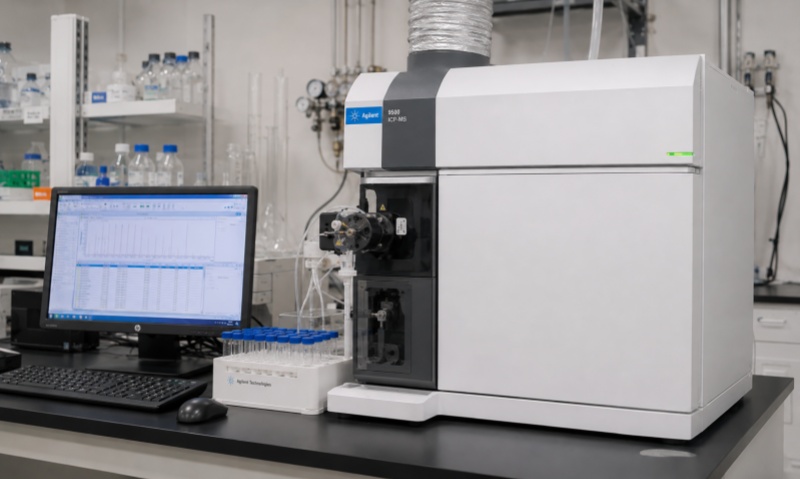
The DC arc spectrometer is a classic and essential atomic emission spectroscopy instrument, which is widely applied in metallurgical component analysis, mineral material detection, non-metallic impurity analysis, and raw material quality inspection in industrial laboratories. Different from modern inductively coupled plasma spectrometers, the DC arc spectrometer adopts direct current arc discharge as the excitation source, featuring simple structure, low operating cost, strong sample adaptability and no need for expensive auxiliary gas. It can directly analyze solid powder, block minerals and metal samples without complex digestion pretreatment, occupying an irreplaceable position in qualitative and semi-quantitative elemental analysis. This paper systematically expounds the overall structure, core working principle, excitation process, spectral separation and detection mechanism of DC arc spectrometer, and analyzes its technical characteristics and operational advantages in practical detection.
The overall working system of the DC arc spectrometer is mainly composed of four core modules: DC arc excitation power supply, electrode discharge system, optical splitting system and spectral detection and reading system. Each module coordinates and operates sequentially to complete the whole process from sample atomization and excitation to spectral signal acquisition and data analysis. The DC excitation power supply is the core energy providing component, which can output stable low-voltage and high-current direct current. It maintains continuous and stable arc discharge between the two electrodes, provides a high-temperature excitation environment for sample atomization, and avoids discharge fluctuation caused by current instability, ensuring the repeatability of spectral signals. The electrode system includes upper and lower graphite electrodes or metal electrodes, which are used to carry samples and conduct current to form arc channels.
The core working principle of the instrument is based on atomic emission spectroscopy theory. All elemental substances have unique internal electron energy level structures. When the sample enters the high-temperature DC arc region, it will undergo a series of physical changes including melting, vaporization, atomization and excitation. The continuous DC arc can form a high-temperature field of 4000K to 7000K between the two electrodes. Under such high-temperature conditions, the solid sample carried by the electrode is rapidly vaporized into gaseous atomic state. The outer electrons of gaseous atoms absorb arc energy and jump from the stable ground state to the unstable excited state. Since the excited state electrons are extremely unstable, they will spontaneously return to the low-energy ground state in a very short time, and release redundant energy in the form of electromagnetic waves, namely characteristic spectral lines.
Each chemical element has unique electron energy level difference, so the wavelength of the emitted characteristic spectral lines is exclusive and fixed, which constitutes the qualitative basis of DC arc spectroscopy. Meanwhile, the intensity of the characteristic spectral lines is positively correlated with the content of the corresponding element in the sample. By detecting the spectral line intensity, the instrument can realize semi-quantitative and quantitative analysis of various elements in the sample. Compared with other excitation methods, the DC arc excitation source has high temperature and strong excitation ability, which can effectively excite most metal elements and part of non-metal elements, and is especially suitable for the detection of trace and micro-content elements in solid samples.
The complete working process of the instrument can be divided into four steps: sample preparation, arc excitation, spectral splitting and signal detection. In the sample preparation stage, the solid sample is ground into uniform powder and evenly filled into the groove of the lower graphite electrode, while the upper electrode is used as the discharge pole to adjust the electrode gap to a fixed distance. After the instrument is powered on, the DC power supply instantly breaks down the air gap between the electrodes to form a stable arc flame, continuously providing high-temperature excitation energy. The sample atoms vaporized and excited by the arc source emit characteristic spectra, which enter the optical splitting system through the optical path diaphragm.
The optical splitting system adopts high-precision grating dispersion technology, which can decompose the complex mixed spectrum emitted by the arc source into single-wavelength monochromatic spectral lines according to different wavelengths. The dispersed characteristic spectral lines are accurately projected onto the photoelectric detection device. The detector converts optical signal intensity into electrical signal data, and transmits it to the supporting analysis software. The system compares the wavelength and intensity of the measured spectral lines with the standard spectral database, so as to complete qualitative identification of element types and quantitative calculation of element content.
In practical detection applications, the stable operation of DC arc discharge is the key to ensure accurate test results. The instrument is equipped with current stabilization and arc stabilization control modules, which can automatically compensate current fluctuations and maintain the stability of arc shape and temperature. Different from pulse arc and AC arc, DC arc has continuous energy output, more sufficient sample atomization and excitation, and higher sensitivity for trace element analysis. However, due to the slight difference in sample burning speed and electrode loss, the instrument needs regular baseline calibration and standard sample correction to eliminate system errors and improve detection accuracy.
In conclusion, the DC arc spectrometer realizes elemental analysis by virtue of DC high-temperature arc excitation and atomic characteristic spectral detection. With its unique advantages of solid sample direct detection, simple operation and low operation cost, it is widely used in industrial raw material screening, mineral resource exploration and material impurity detection. A thorough understanding of its working principle is conducive to standardizing instrument operation, optimizing detection parameters, avoiding operational errors, and giving full play to the instrument’s detection performance, so as to provide accurate and reliable data support for industrial production and scientific research experiments.