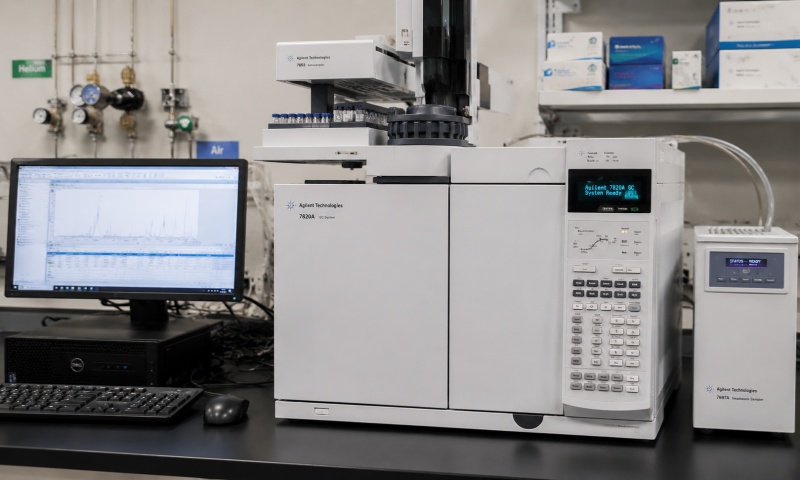
Gas Chromatography (GC) is one of the most widely used analytical instruments in chemical testing, pharmaceutical analysis, environmental monitoring, food safety and petrochemical laboratories. As the core signal acquisition component of gas chromatography, the detector is responsible for converting separated compound components into identifiable electrical signals, which directly determines the accuracy, sensitivity and stability of chromatographic detection results. During long-term continuous analysis, residual samples, high-boiling impurities, carbon deposits and stationary phase fragments will gradually accumulate inside the detector chamber, nozzle and electrode system. Common symptoms such as baseline drift, irregular noise, ghost peaks, reduced sensitivity and poor peak symmetry are mostly caused by contaminated detector components. Therefore, standardized and regular cleaning of GC detectors is an essential routine maintenance operation to ensure stable instrument performance and reliable experimental data. This article mainly introduces the pollution causes, standardized cleaning procedures and targeted maintenance methods for mainstream GC detectors including FID, TCD and ECD.
Understanding the sources and hazards of detector contamination is the premise of scientific cleaning. In daily detection processes, incomplete volatilization of high-boiling substances, residual matrix impurities in complex samples, excessive injection volume, and long-term high-temperature combustion will form carbon accumulation and oily pollution inside the detector cavity. For Flame Ionization Detector (FID), the most commonly used detector in laboratories, pollutants are mainly combustion carbon deposits and unburned organic residues attached to the nozzle, collector pole and ignition electrode. Thermal Conductivity Detector (TCD) is prone to dust accumulation and residual condensed substances on the thermal wire, resulting in unbalanced bridge circuit and unstable baseline. Electron Capture Detector (ECD), which is highly sensitive to trace impurities, is easily affected by residual halogen compounds and contaminated gas paths, leading to increased baseline noise and decreased detection sensitivity. If these pollutants are not cleaned in time, they will cause continuous signal interference, seriously affect the repeatability of retention time and peak area, and even lead to irreversible aging of detector components.
Before carrying out any detector cleaning operation, standardized pre-operation preparation and safety precautions must be strictly implemented to avoid secondary damage and safety risks. First, stop the instrument analysis program, turn off the column oven and detector heating system, and wait for the detector temperature to drop below 60 degrees Celsius to prevent high-temperature scalding and component damage during disassembly. Second, close the carrier gas, hydrogen and air supply in sequence, release the internal pipeline pressure, and cut off the instrument power supply to ensure safe disassembly and maintenance. Prepare special laboratory cleaning tools, including anhydrous ethanol, chromatographic pure methanol, soft cotton swabs, dust-free lens paper, ultrasonic cleaner and special detector disassembly tools. It is necessary to avoid using hard tools such as tweezers and blades to prevent scratching the precision nozzle, electrode and thermal wire components. In addition, the entire disassembly and cleaning process should be carried out in a dust-free and dry environment to prevent secondary dust pollution.
For FID detectors, the most practical and widely used cleaning method is ultrasonic solvent cleaning combined with high-temperature baking. After cooling and powering off, disassemble the FID upper cover, ignition wire, collector pole, nozzle and sealing gasket in sequence, and place the disassembled metal accessories into an ultrasonic cleaning tank. Use chromatographic methanol or anhydrous ethanol as the cleaning solvent for 10 to 15 minutes of ultrasonic cleaning to fully dissolve organic carbon deposits and oily impurities. For severely blocked nozzles with thick carbon deposits, soak the parts in solvent for 30 minutes before ultrasonic cleaning to improve the cleaning effect. After cleaning, take out the accessories, wipe them gently with dust-free paper, and place them in a constant-temperature drying oven for drying. After all components are completely dry, reassemble them in the original order, install new sealing gaskets to ensure airtightness, and avoid air leakage caused by aging accessories.
TCD and ECD detectors require more refined and targeted cleaning methods due to their high-precision sensing structures. The thermal wire of TCD is extremely delicate and easily deformed, so it is not suitable for strong ultrasonic cleaning. It is only necessary to gently wipe the surface of the thermal wire and the inner wall of the detection chamber with a soft cotton swab dipped in a small amount of anhydrous ethanol to remove surface floating dust and condensed impurities. For internal pipeline residual pollutants, low-flow pure carrier gas purging can be adopted for continuous purging and cleaning. ECD detectors are highly sensitive to moisture and impurities. It is forbidden to use excessive liquid solvent for cleaning. Regular high-temperature baking purification is the main maintenance method. Set the detector temperature to 300 to 350 degrees Celsius, maintain high-purity nitrogen purging for 2 to 4 hours, and remove residual halogen impurities and moisture in the gas path and detection cavity to restore detector sensitivity.
After cleaning and reassembly, systematic instrument balancing and performance verification must be completed before formal use. Turn on the instrument power and gas supply system, strictly follow the startup sequence, and preheat and balance the detector for more than 1 hour. Observe the baseline stability in the baseline monitoring interface. When the baseline is flat without drift and irregular noise, conduct standard sample calibration and repeatability tests. Compare the peak shape, response value and retention time repeatability before and after cleaning to verify whether the cleaning effect meets the standard. If the baseline is still unstable or the sensitivity is insufficient, repeat the solvent cleaning and high-temperature baking process again.
In conclusion, detector contamination is the main cause of GC instrument performance degradation and abnormal detection data. Scientific and standardized cleaning methods can effectively remove carbon deposits, organic residues and pipeline impurities, restore detector sensitivity and stability, and extend the service life of core components. Laboratories should formulate regular detector cleaning and maintenance cycles according to sample matrix complexity and instrument use frequency. Standard cleaning operation and daily maintenance can effectively reduce instrument failure rate, improve detection accuracy, and provide stable and reliable technical support for various gas chromatographic analysis experiments.