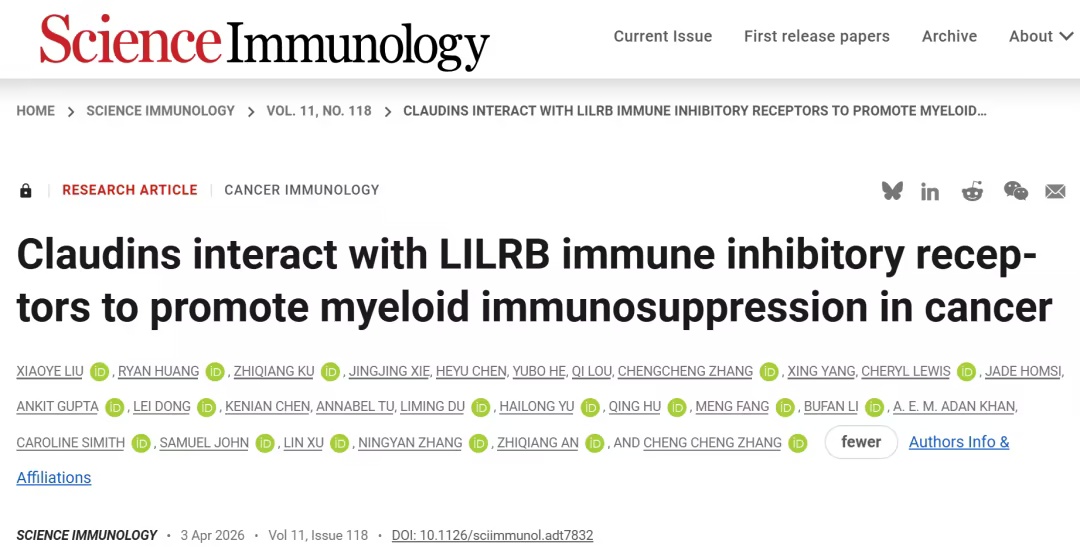
Immunotherapy has revolutionized the treatment of cancer, but many tumors still escape immune surveillance through various mechanisms, leading to treatment failure. The tumor microenvironment (TME) is a complex ecosystem where tumor cells interact closely with immune cells, and the abnormal crosstalk between them is a key driver of tumor immune escape. On April 3, 2026, the team led by Professor Zhang Chengcheng from the University of Texas Southwestern Medical Center published a landmark study in Science Immunology, a subjournal of Science, revealing a novel immune escape mechanism: tumor cells hijack the immune system by using their own adhesion proteins, forming a "conspiracy" with immune cells to promote tumor progression. This study identifies a new therapeutic target and provides a potential biomarker for cancer immunotherapy, with profound implications for improving the efficacy of clinical treatment.
The research focuses on claudins (CLDNs), a family of tight junction proteins that are normally expressed on epithelial and endothelial cells, playing a key role in maintaining cell integrity and barrier function. However, in cancer cells, the expression of CLDNs is dysregulated, and their specific role in tumor immune escape has long remained unclear. Professor Zhang Chengcheng’s team conducted systematic screening and functional verification, and for the first time identified that CLDNs are novel functional ligands for leukocyte immunoglobulin-like receptor subfamily B (LILRB2 and LILRB5).
LILRB2, a member of the LILRB family, is an inhibitory receptor expressed on myeloid cells, including macrophages, monocytes, and myeloid-derived suppressor cells (MDSCs). It contains an immunoreceptor tyrosine-based inhibitory motif (ITIM) in its intracellular domain; when bound to its ligand, it recruits phosphatases such as SHP-1 and SHP-2 to inhibit immune activation, making it a promising "myeloid immune checkpoint". The team’s experiments confirmed that CLDNs, especially CLDN18.2 (abnormally expressed in gastric cancer, pancreatic cancer, and biliary tract cancer), can specifically bind to LILRB2 and LILRB5, triggering bidirectional signal transduction in the TME.
In both syngeneic LILRB2 transgenic mouse models and humanized mouse models, the interaction between CLDN18.2 and LILRB2 significantly enhanced the immunosuppressive activity of myeloid cells. Specifically, this binding activated the NF-κB and STAT signaling pathways in myeloid cells, promoting the secretion of immunosuppressive factors such as IL-10 and TGF-β, while inhibiting the production of pro-inflammatory cytokines. As a result, the anti-tumor activity of T cells and natural killer (NK) cells was suppressed, and tumor progression was accelerated. Importantly, blocking LILRB2 effectively reversed these immunosuppressive effects, restoring the anti-tumor immune response and inhibiting tumor growth.
To verify the clinical relevance of this pathway, the researchers analyzed five human cancer cohorts and found that the spatial proximity between LILRB2-positive macrophages and CLDN-expressing cancer cells was closely associated with poor clinical outcomes. This finding suggests that the CLDN-LILRB axis can serve as a potential predictive biomarker for patient response to myeloid checkpoint blockade therapy, helping to screen patients who may benefit from targeted treatment.
Previous studies on tumor immune escape have mainly focused on T cell checkpoints such as PD-1/PD-L1, but many patients still do not respond to T cell checkpoint inhibitors, indicating the existence of other unrecognized immune escape mechanisms. Myeloid cells are the most abundant immune cells in the TME, and their transformation into immunosuppressive cells is a key obstacle to anti-tumor immunity. This study reveals the regulatory role of CLDNs in myeloid cell function, supplementing the understanding of tumor immune escape mechanisms centered on myeloid cells.
Professor Zhang Chengcheng pointed out that the CLDN-LILRB axis provides a new target for cancer immunotherapy. Currently, several clinical trials targeting LILRB receptors are underway, and this study suggests that combining LILRB2 blockers with CLDN-targeted therapies may achieve better therapeutic effects, especially for tumors with high CLDN expression. In addition, the spatial relationship between LILRB2-positive macrophages and CLDN-expressing tumor cells can be used as a biomarker to guide personalized immunotherapy.
In conclusion, this study by Zhang Chengcheng’s team uncovers a new pathway by which tumor cells hijack the immune system through their own adhesion proteins (CLDNs), revealing the "conspiracy" between tumor cells and myeloid cells in the TME. It not only enriches the theoretical system of tumor immune escape but also provides new ideas and targets for improving the efficacy of cancer immunotherapy. As research in this field progresses, it is expected that targeted therapies against the CLDN-LILRB axis will bring new hope to more cancer patients.