The headspace autosampler is a crucial supporting device for gas chromatography, which is widely applied in food safety testing, pharmaceutical analysis, environmental monitoring, and chemical component detection. It achieves quantitative analysis of volatile and semi-volatile organic compounds by extracting gas-phase components from sealed sample vials. During long-term continuous operation, residual sample contaminants, organic residues, and particulate impurities will adhere to the sampling needle, transfer pipeline, heating chamber, and sealing components of the headspace sampler. Without regular standardized cleaning, residual pollutants will cause cross-contamination of samples, distorted detection data, peak distortion, baseline drift, and even blockage of internal pipelines, seriously affecting the accuracy and stability of chromatographic detection. To ensure stable instrument performance and reliable experimental data, this paper systematically introduces the standard cleaning steps of the headspace autosampler using pure water, methanol, and absolute ethanol, as well as key cleaning specifications and maintenance precautions.
Before implementing the formal cleaning process, it is essential to complete pre-operation preparation and safety inspection to avoid secondary damage to the instrument and potential safety hazards. First, stop all running detection programs of the instrument, turn off the heating and sampling functions of the headspace sampler, and wait for the heating furnace body and sampling pipeline to cool down to room temperature completely. High-temperature cleaning will cause rapid volatilization of organic solvents, leading to pipeline corrosion and component aging. Second, cut off the instrument power and gas supply to ensure the whole cleaning process is carried out in a power-off and pressure-relief state. Prepare standard cleaning reagents in advance, including laboratory-grade pure water, chromatographically pure methanol, and chromatographically pure absolute ethanol, as well as auxiliary tools such as special sample vials, cleaning syringes, dust-free cotton swabs, and lint-free wiping cloths. It is necessary to confirm that all cleaning reagents are free of impurities and pollution to avoid introducing new contaminants during the cleaning process.
The first step of formal cleaning is routine flushing with pure water, which is mainly used to remove water-soluble impurities, residual aqueous sample solutions, and surface dust in the sampling system. Prepare multiple clean headspace sample vials, inject pure water into the vials, and place them in the sample tray of the headspace sampler. Set the instrument to the manual sampling and flushing mode, turn on the internal pipeline circulation flushing function, and use pure water to repeatedly flush the sampling needle, quantitative loop, transfer pipeline, and valve body runner. The flushing frequency shall be no less than 5 cycles to fully dissolve and wash away water-soluble residual substances attached to the inner wall of the pipeline and the surface of the sampling needle. After pure water flushing, let the pure water stay in the pipeline for 3 to 5 minutes for static soaking, so as to fully dilute stubborn water-soluble pollutants, and then complete the residual liquid discharge. Pure water cleaning is the primary link of daily maintenance, which can effectively prevent water-based residue accumulation and avoid basic pipeline blockage.
The second core cleaning step is deep decontamination with methanol. Methanol has strong solubility for most organic volatile residues, lipid impurities, and macromolecular organic pollutants, which is suitable for removing stubborn organic contaminants that cannot be cleaned by pure water alone. Replace the sample vials with chromatographically pure methanol, and adopt the same manual flushing mode to perform cyclic flushing on the headspace sampling system. Set a slightly longer flushing time, and conduct 6 to 8 cycles of continuous flushing to ensure that methanol fully contacts all internal flow paths, needle holes, and valve cavities. For trace organic residues adsorbed on the inner wall of the pipeline and the surface of precision components, methanol can effectively dissolve and strip pollutants. In view of the easily contaminated parts such as the sampling needle outer wall and the vial sealing gasket, wipe them gently with a dust-free cotton swab dipped in methanol to remove surface organic attachments. After methanol cleaning, discharge all residual methanol liquid to prevent organic solvent residue from affecting subsequent sample detection.
The final fine cleaning step is purification and dehydration with absolute ethanol. Absolute ethanol has both good organic solubility and high volatility, which can remove residual methanol traces and insoluble fine impurities, and achieve rapid drying and dehydration of the pipeline. Use chromatographically pure absolute ethanol to replace methanol in sample vials, and perform 3 to 4 cycles of circulating flushing on the instrument flow path. Absolute ethanol can thoroughly clean the residual methanol in the dead corners of the pipeline, micro gaps of the valve body, and needle inner holes, avoiding cross-solvent interference in subsequent experiments. Meanwhile, wipe the instrument surface, sample tray, and vial heating tank with a lint-free cloth dipped in absolute ethanol to remove surface stains and residual pollutants. After the ethanol flushing is completed, keep the instrument pipeline unobstructed, and use the instrument’s own gas circuit to blow dry the internal flow path for 10 to 15 minutes to completely volatilize residual ethanol and moisture, ensuring no liquid residue inside the system.
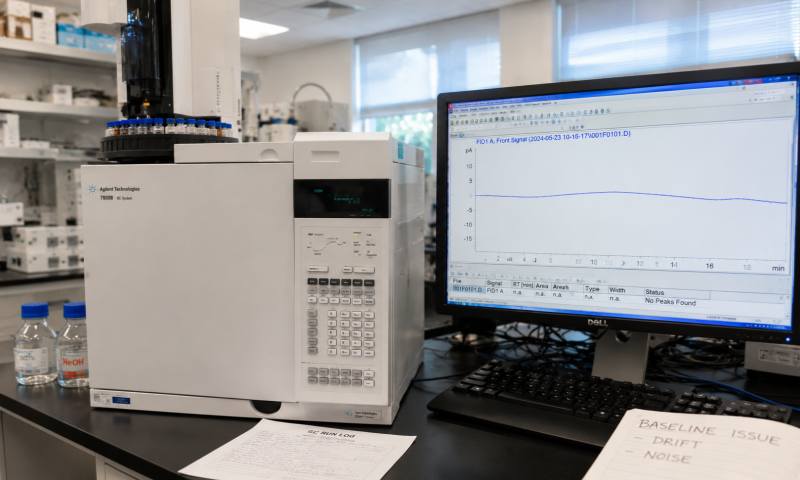
After completing all cleaning operations, standardized inspection and reset work must be carried out. First, check all parts of the sampling system to confirm that there is no residual liquid, no pipeline blockage, and no surface pollutants. Then restore the instrument parameters, turn on the power and gas supply, and conduct idle operation and blank detection. Observe the chromatographic baseline and peak state to confirm that there is no miscellaneous peak interference and baseline drift, which indicates that the cleaning effect meets the experimental standards. In daily maintenance, the headspace sampler should be cleaned with pure water, methanol, and absolute ethanol in a regular cycle. Daily light cleaning adopts pure water flushing, and weekly deep maintenance adopts the combined cleaning process of methanol and absolute ethanol, which can effectively maintain the precision and stability of the instrument.
In conclusion, the standardized cleaning process with pure water, methanol and absolute ethanol is the key measure to ensure the stable operation of the headspace autosampler. Pure water removes water-soluble impurities, methanol eliminates stubborn organic residues, and absolute ethanol realizes residual purification and rapid drying. Scientific and standardized cleaning operations can effectively avoid sample cross-contamination and detection data errors, extend the service life of instrument pipelines and precision components, and provide accurate and stable technical support for various chromatographic detection experiments.